Dublin arrival day
Land, get into the city, drop bags, and keep the day flexible. Trinity, Grafton Street, St Stephen's Green, or a central museum can work if energy is good.
Read the Dublin arrival day plan10-day route
With 10 days in Ireland, you can finally connect Dublin, the west, and part of the southwest without making every day a transfer. The trick is still restraint: use two or three strong bases, keep a weather-flex day, and do not try to turn 10 days into the whole island.
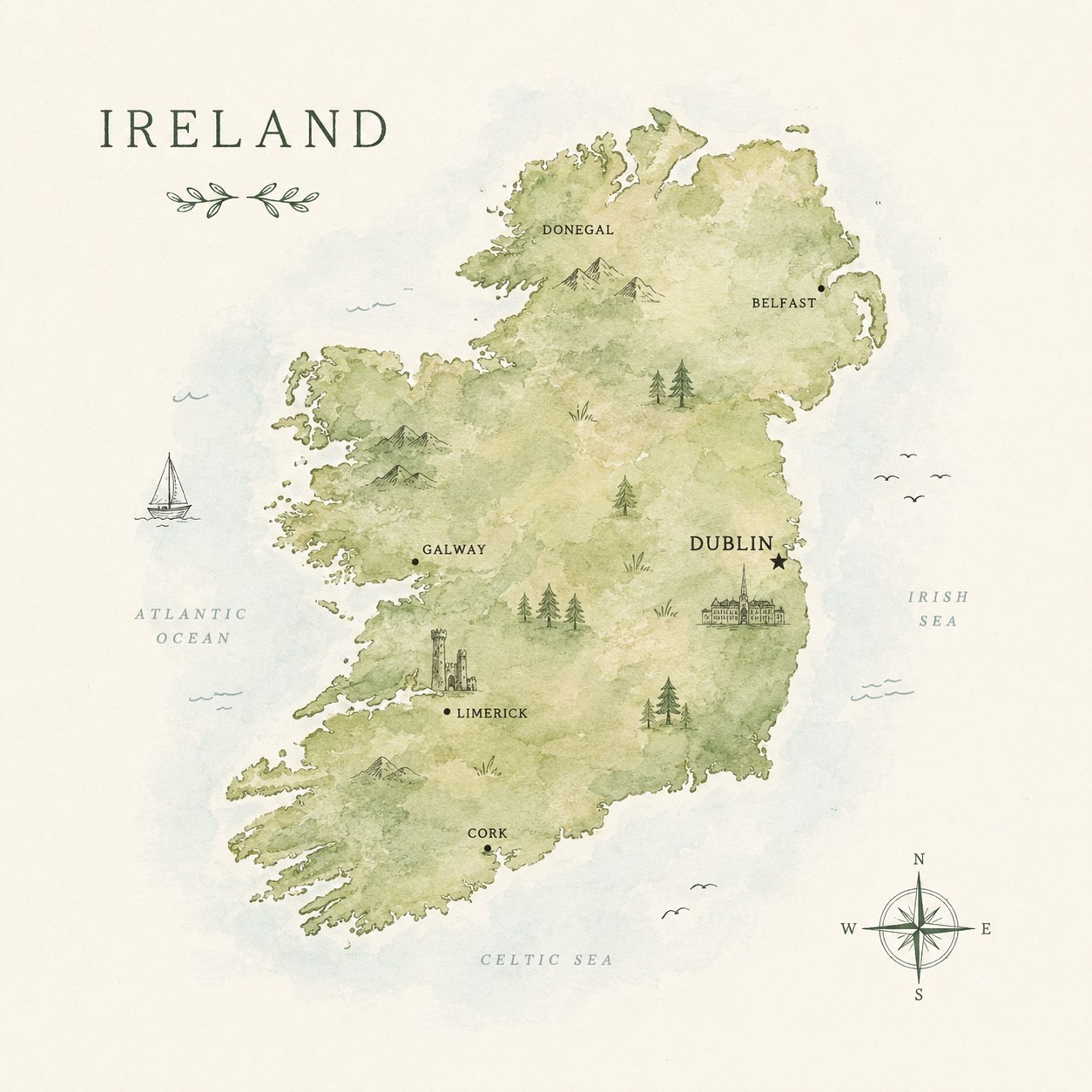
The route at a glance
For most first-time visitors, the strongest 10-day Ireland itinerary is 2 nights in Dublin, 3 nights around Galway or Clare, 3 nights in the southwest, and 1 final night near Dublin or the airport. That gives you city time, Atlantic scenery, one proper Kerry or Cork section, and a safer departure buffer.
Best route
| Day | Base | Plan | Why it works |
|---|---|---|---|
| 1 | Dublin | Arrival, light city walk, early dinner. | You protect the jet-lag day and avoid collecting a car too early. |
| 2 | Dublin | One major paid stop, one compact walking area, easy evening. | Dublin works best when you group nearby sights instead of crossing the city repeatedly. |
| 3 | Galway | Travel west by train, bus, or car; Galway city evening. | Galway gives immediate payoff and supports both car and no-car routes. |
| 4 | Galway or Doolin | Aran Islands, Cliffs of Moher, or the Burren. | This is your first proper Atlantic day, with choices based on weather and transport. |
| 5 | Galway, Clare, or Connemara | Connemara, Clare coast, or a slower Galway day. | A flexible day keeps the west from becoming a one-stop checklist. |
| 6 | Killarney, Kenmare, or Cork | Move south, keeping the transfer as the main event. | This is the day to connect regions, not to stack three scenic detours. |
| 7 | Killarney or Kenmare | Killarney National Park, Gap of Dunloe, or a gentler Kerry day. | You get a southwest day without immediately committing to the biggest loop. |
| 8 | Killarney, Kenmare, or Dingle | Ring of Kerry or Dingle/Slea Head, not both rushed. | Choosing one big scenic route makes the day memorable instead of exhausting. |
| 9 | Cork, Kinsale, or Dublin area | Cork/Kinsale/Cobh if south-focused, or return east if your flight is early. | The final route shape depends on flight timing and whether you want food/coast or a buffer. |
| 10 | Departure | Short final walk, car return, airport, or home flight. | The last day stays low-risk instead of starting with a long rural drive. |
Day by day
Land, get into the city, drop bags, and keep the day flexible. Trinity, Grafton Street, St Stephen's Green, or a central museum can work if energy is good.
Read the Dublin arrival day planChoose Book of Kells, Guinness Storehouse, Kilmainham Gaol, EPIC, or a museum area. Keep bookings near each other and avoid renting a car for the city.
Train and bus both make sense if you are not driving yet. If you are renting, pick up the car after Dublin and use the evening for Galway rather than a faraway detour.
Pick one main west-coast experience. Ferries and cliff walks are weather-sensitive, so check conditions close to the day and keep a town or shorter-drive backup.
This is the day that makes 10 days feel better than 7. Do not spend it proving you can reach another faraway region.
The west-to-south transfer is real. Choose a direct move to Killarney, Kenmare, Cork, or Kinsale and treat anything extra as optional.
If you chose Kerry, use this for Killarney National Park, Muckross, Gap of Dunloe, or a slower local day. If you chose Cork, use Cobh, Kinsale, or the city food scene.
Choose Ring of Kerry or Dingle/Slea Head if you are in Kerry. Do not add both as a same-day endurance test.
Compare Dingle and Ring of KerryIf your flight is early, return toward Dublin or the airport area. If your flight is late the next day, Cork, Kinsale, or a final Dublin night can work.
Keep the final morning simple. Allow time for car return, luggage, airport transport, and the possibility that the route takes longer than expected.
Route versions
Dublin, Galway/Clare, Killarney or Kenmare, then back east. Best if you want the clearest mix of city, west coast, and Kerry scenery.
Dublin, Galway, Cork or Kinsale, then Killarney. Best if food, Cobh, Kinsale, and the south matter as much as cliffs and islands.
Dublin, Galway, Cork, and Killarney by train or bus, with tours for cliffs, Connemara, Ring of Kerry, or Dingle. It works, but rural flexibility is lower.
Car or no car
Skip the car in Dublin, then rent for the west and southwest. A car earns its keep for Connemara, Clare, Kerry, Dingle, Kenmare, and rural stops, but it also adds parking, narrow roads, insurance questions, and fatigue.
Decide if you need a carUse Dublin, Galway, Cork, and Killarney as rail or bus-friendly bases. Add day tours for rural scenery where public transport would waste too much time.
Plan Ireland without a carWhat to skip
Dublin, Galway, Clare, Dingle, Ring of Kerry, Cork, Belfast, Donegal, and Giant's Causeway is too much for this route.
Ten days feels generous only if you use it for better bases. Too many one-night stays turn the route into check-in logistics.
Pick one big scenic route, or add enough southwest nights to make both worthwhile.
Related guides
FAQ
Yes. Ten days is enough for a strong first Ireland trip if you choose Dublin, one western base, and one southwest base. It is not enough to cover every famous region well.
For most first-time visitors, the best version is Dublin for 2 nights, Galway or Clare for 3 nights, Kerry or Cork for 3 nights, and a final night positioned for departure.
Yes, if you use Dublin, Galway, Cork, and Killarney as bases and book tours for rural scenery. A no-car trip is simpler between cities and less flexible in remote areas.
Only if Belfast and the north are a major priority. For a first trip focused on the west and southwest, adding the north usually forces too many cuts elsewhere.
Yes, if you use the extra time for a second region or weather buffer. Seven days is usually Dublin plus one main region; 10 days can add the southwest more comfortably.
Sources
Choose the southwest day
Dingle and the Ring of Kerry are both excellent, but they reward different bases and trip styles.